
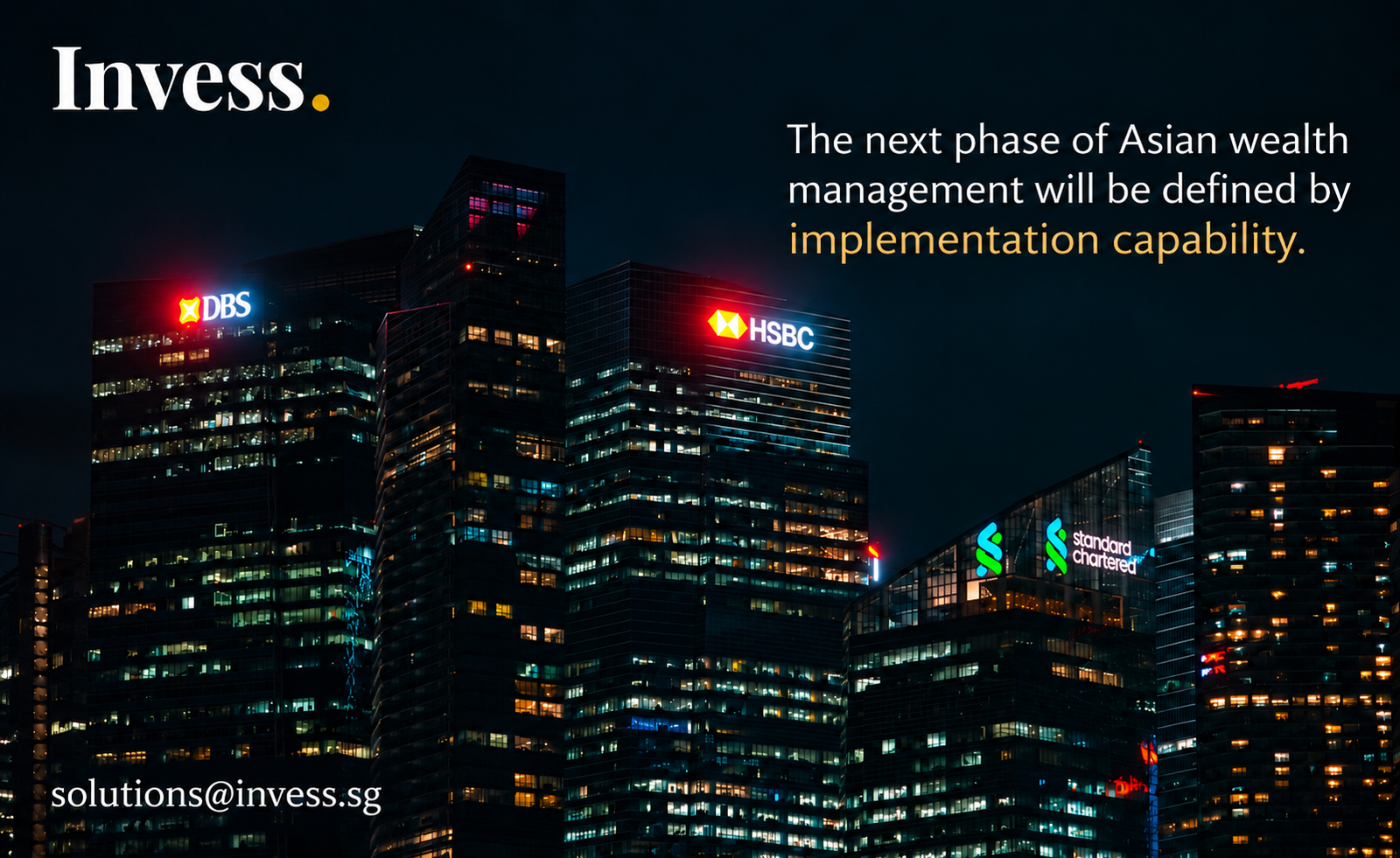
Asia’s expanding private wealth is changing the economics of private banking. Asset gathering remains central to the business, but investment activity, treasury relationships and cross-border capital deployment are becoming increasingly important to the commercial performance of the region’s leading financial institutions.
The first-half results from DBS and HSBC illustrate the shift. DBS reported wealth assets under management of SGD 516 billion at the end of June 2026, while HSBC recorded 18% growth in wealth fee and other income during the first half on a constant-currency basis.
For private-bank executives, wealth-management CIOs and investment committees, the significance extends beyond revenue growth. Larger and more internationally connected portfolios create increasingly complex requirements around investment implementation, liquidity, financing and risk management.
The question is not simply how much capital an institution can attract, but how effectively its investment and operating capabilities can support the deployment, preservation and management of that capital.
Asset accumulation and revenue productivity
DBS crossed SGD 500 billion in wealth assets under management during the second quarter, reaching SGD 516 billion, an increase of 16% year on year in constant-currency terms. Wealth-management fees rose 42% to SGD 919 million, contributing to a 25% increase in group net fee income to SGD 1.46 billion.
HSBC reported a similar development. Wealth fee and other income increased 18% during the first half, while second-quarter revenue from these activities rose 21% to USD 2.8 billion. Investment distribution grew 26%, private banking 22% and asset management 7%.
At DBS, wealth fees expanded considerably faster than assets under management, suggesting that client investment activity and revenue generation from the existing franchise contributed materially to growth. HSBC’s results likewise demonstrate the commercial importance of investment services alongside the accumulation of client assets.
These measures should not be confused with investment performance. Higher fees can reflect market activity, transaction volumes, asset mix and pricing rather than improved risk-adjusted outcomes for clients. Nor does a strong quarter necessarily establish the durability of recurring revenue.
For private banks, the distinction matters because the economics of the relationship depend on more than portfolio size. Revenue quality is influenced by the breadth of services used, the stability of assets, financing activity, investment implementation and the institution’s ability to retain client relationships across market cycles.
A client holding substantial assets in low-turnover investments may contribute differently from one with similar wealth but more extensive treasury, financing and portfolio-management requirements. The appropriate commercial response is not necessarily to encourage greater investment turnover, but to address the financial requirements arising from the client’s wider capital structure.
The strategic challenge is to improve the depth and productivity of the relationship without allowing revenue considerations to compromise investment suitability, governance or the client’s underlying mandate.
The investment mandate is becoming more complex
Asia’s wealth expansion includes entrepreneurs approaching liquidity events, internationally active families and investment entities holding assets across several jurisdictions.
Their portfolios may combine concentrated listed equities, privately owned businesses, real estate, alternative investments and substantial cash reserves. These holdings carry different investment horizons, financing requirements, currencies and liquidity obligations.
For a family office, the investment problem may involve retaining exposure to a concentrated equity position while limiting the consequences of a severe drawdown. Another may need to reconcile long-duration private-market commitments with predictable distributions and future capital calls.
Private-bank investment committees face comparable questions when implementing investment themes across portfolios with different risk budgets, downside tolerances and governance requirements.
A client may have a positive long-term view on a particular equity market but lack the capacity to absorb unrestricted losses over the relevant investment horizon. Another may require exposure to an investment strategy while preserving liquidity for commitments that cannot be deferred.
In both cases, the investment thesis and the appropriate implementation are separate decisions.
The distinction becomes particularly important where wealth is concentrated in assets that cannot readily be diversified or liquidated. A business owner may be economically exposed to one sector through an operating company, a listed-equity portfolio and private investments. The portfolio can appear diversified by legal ownership while remaining dependent on the same economic conditions.
Investment committees therefore need to consider total exposure across the client’s balance sheet rather than assessing each allocation independently.
This includes the relationship between market risk, liquidity obligations, financing arrangements and the potential correlation of assets during periods of stress.
Broader investment-product availability does not necessarily resolve these constraints. The more relevant capability is the ability to translate a defined investment objective into an exposure consistent with the portfolio’s wider risk and capital requirements.
Treasury and investment capital are converging
DBS reported treasury customer income of SGD 924 million in the second quarter of 2026, approximately 42% higher than a year earlier, supported by activity across wealth-management and corporate clients.
The figure is not exclusively wealth-management revenue, but it demonstrates the scale of treasury activity within the broader banking franchise.
For institutional wealth platforms, the connection between treasury and investment management is particularly relevant where capital serves several distinct purposes.
An internationally active family may hold liquidity for operating companies, private-market commitments, distributions and strategic acquisitions. A corporate treasury may need to fund working capital, manage currency exposures and preserve reserves for planned expenditure.
These requirements cannot necessarily be addressed through a single investment allocation.
Operating liquidity generally requires immediate or predictable access, limited market risk and close alignment with payment obligations. Strategic reserves may support longer investment horizons, while other capital pools can tolerate greater volatility or illiquidity in pursuit of additional returns.
The distinction is not simply between cash and investments. It is between capital that must remain available under defined conditions and capital that can be committed to longer-term objectives.
That separation affects the appropriate maturity, currency, counterparty exposure and permissible downside of each allocation.
A higher-yielding investment may be unsuitable for an operating reserve if its secondary-market liquidity deteriorates when capital is required. Conversely, retaining excessive long-term capital in immediately accessible instruments can introduce opportunity costs and reinvestment uncertainty.
For private banks, this creates an implementation challenge extending beyond conventional cash management. Liquidity segmentation, financing arrangements and investment construction need to be considered together where obligations are interconnected.
The objective is to establish a capital architecture in which each reserve serves a defined purpose and the pursuit of additional return does not compromise its intended function.
Cross-border wealth requires more than market access
Boston Consulting Group’s 2026 Global Wealth Report identified Hong Kong as the world’s largest cross-border wealth-management centre, with approximately USD 2.9 trillion in cross-border assets booked in 2025, narrowly ahead of Switzerland.
The development reflects the importance of Asian financial centres in serving internationally mobile capital.
DBS has announced plans for 18 additional wealth centres by the end of 2027. Its partnership with Samsung Securities aims to broaden access to Korean capital markets and international investment opportunities. In September, DBS expanded its partnership with Avaloq to strengthen adviser capabilities and wealth infrastructure, supporting its ambition to reach SGD 1 trillion in combined retail and wealth assets under management by 2030.
These initiatives demonstrate the investment being made in regional infrastructure and institutional connectivity.
For CIOs and investment committees, however, access to another market is only one part of the investment decision.
Cross-border portfolios introduce currency exposure, jurisdictional constraints, custody requirements, counterparty considerations and differences in market liquidity. An investment attractive in its domestic market may produce a materially different outcome after hedging costs, financing terms and base-currency obligations are considered.
The currency decision can be particularly consequential where the underlying asset and the liabilities supported by the investment are denominated differently.
An institution may hold an attractive foreign-currency investment while facing domestic-currency distributions or commitments. Hedging can reduce uncertainty, but its cost, tenor, collateral requirements and effectiveness must be assessed against the intended holding period.
Cross-border implementation also creates operational considerations. The availability of an investment through a particular market or platform does not establish that its custody arrangements, legal structure or counterparty exposure are appropriate for every mandate.
Geographic diversification can therefore increase the number of markets represented without materially reducing the portfolio’s dependence on common economic risks.
Holdings across different jurisdictions may remain sensitive to the same interest-rate environment, refinancing conditions, global liquidity cycle or concentration in a particular investment theme.
For institutional allocators, the relevant measure is not simply the breadth of international access, but whether that access improves the portfolio’s underlying economic diversification and implementation efficiency.
Portfolio construction beyond product availability
Private banks can offer access to public securities, private assets, alternative strategies and structured investments across an increasingly broad opportunity set.
Yet a larger investment universe does not necessarily produce a better constructed portfolio.
Listed equities, private credit and infrastructure investments may appear distinct in an allocation report while retaining common exposure to leverage, financing costs, valuations and underlying cash flows.
An institution allocating to technology equities, data-centre infrastructure and private credit financing the same investment cycle may hold several instruments while remaining dependent on similar assumptions about demand, capital expenditure and financing availability.
The same problem can arise across real estate, private equity and corporate credit when several allocations depend on refinancing conditions or the availability of external capital.
For CIOs and portfolio managers, the relevant question is what each exposure contributes to the mandate and whether the portfolio is adequately compensated for the economic risks being retained.
An income allocation has different requirements from one intended to preserve capital, introduce asymmetric participation, manage downside or capture long-term growth.
Those objectives determine the appropriate risk budget, liquidity profile, investment horizon and implementation framework.
An investment may remain fundamentally attractive while its conventional risk profile becomes unsuitable for the portfolio. A manager may wish to preserve participation in an equity strategy but operate within a defined maximum acceptable loss. A family office may retain a long-term investment theme while requiring greater certainty over capital available for future commitments.
The appropriate response need not be to abandon the investment thesis.
Where conventional instruments meet the mandate efficiently, additional structuring may offer little value. Where the required exposure conflicts with the portfolio’s risk or liquidity constraints, financial engineering can provide an alternative means of implementation.
This may involve altering participation, defining downside, managing currency exposure or introducing financing arrangements consistent with the wider capital objective.
Such approaches are not without cost. Protection, hedging and bespoke exposure construction can involve reduced upside, issuer credit risk, additional expenses or restrictions on secondary-market liquidity.
The economic test is whether the resulting structure improves the balance between expected return, capital committed, liquidity and risk relative to the available alternatives.
Complexity is justified only when it solves a specific investment problem.
The institutional operating model is evolving
The increasing sophistication of wealth-management requirements also raises questions about which capabilities institutions should maintain internally and which can be accessed through specialist counterparties.
Investment governance, strategic asset allocation, manager oversight and client relationships remain central institutional responsibilities.
Specialist financial engineering, payoff construction and bespoke exposure design may complement those functions where a mandate requires capabilities that are not economically efficient to maintain independently.
The distinction is between retaining responsibility for investment decisions and maintaining every technical capability required to implement them.
A private bank may possess the investment judgment, client knowledge and governance framework needed to define a portfolio objective while requiring specialist expertise to construct a particular exposure or financing arrangement.
Similarly, a family office may retain strategic control of its investment process while accessing external capabilities for selected implementation requirements.
This does not remove the need for counterparty oversight, legal review, valuation transparency or ongoing risk governance. Specialist arrangements must remain consistent with the institution’s operating model and responsibilities.
Invess operates within this institutional framework, designing bespoke financial engineering and capital solutions exclusively for institutional clients around defined investment, financing, liquidity and risk objectives.
Each engagement begins with the mandate rather than a predefined product. Where bank issuance is appropriate, structures are issued through A-rated investment banks.
Invess’ role is to engineer an implementation architecture around the required investment outcome, not to distribute a product range or replace the institution’s investment judgment.
The value of specialist implementation lies in whether it improves the relationship between market participation, acceptable downside, liquidity and capital efficiency within the existing governance framework.
The next phase of Asian wealth management
The DBS and HSBC results point to a broader change in the economics of Asian wealth management. Asset accumulation remains essential, but investment activity, treasury relationships and cross-border capabilities are increasingly important to the commercial depth of the client relationship.
The expansion of private wealth also brings greater complexity. Internationally diversified portfolios, concentrated holdings, financing requirements and competing liquidity obligations create demands that cannot always be addressed through conventional investment access alone.
For private banks and institutional wealth managers, the challenge is to combine investment judgment and portfolio governance with the implementation capabilities required to manage those demands.
A broader product range may improve access, but it does not necessarily improve capital allocation. Similarly, stronger fee generation does not by itself demonstrate that client portfolios are more resilient or better aligned with their mandates.
The more durable competitive advantage may belong to institutions able to distinguish between the investment exposure clients require and the risks they need not retain, while maintaining discipline over liquidity, financing and implementation.
Asia’s next phase of wealth-management growth may depend less on the volume of assets accumulated than on the institutional capabilities available to structure, deploy and preserve the capital entrusted to them.